
Resources / Use case: tourism and destinations
How CVBs and DMOs Use Local Outlet Marketing to Reach Travelers
A practical look at how visitor bureaus partner with local outlets to stay in front of travelers all year, with an example from Michigan.
By the Greater Wave team
Convention and visitors bureaus (CVBs) and destination marketing organizations (DMOs) have a specific job: get people who could visit to actually plan the trip. Most of those people live within driving distance, and most of them already follow accounts that cover their state or region. Local Outlet Marketing (LOM) puts a destination in front of that audience through a source they already trust.
Why local outlets fit destination marketing
A statewide or regional outlet has spent years building an audience of people who live in, travel around, and care about that place. For a destination, that is close to the ideal audience: nearby, interested, and already in the habit of saving and sharing places to go.
A partnership with a local outlet sits somewhere between hiring an influencer and earning coverage from a news outlet.
| Channel | Trust and engagement | Cost | Targeting |
|---|---|---|---|
| Local outlet partnership | High | Affordable | Focused |
| Traditional influencers | Moderate | Expensive | Mixed |
| Legacy media and news | Low | Unreliable or expensive | Broad |
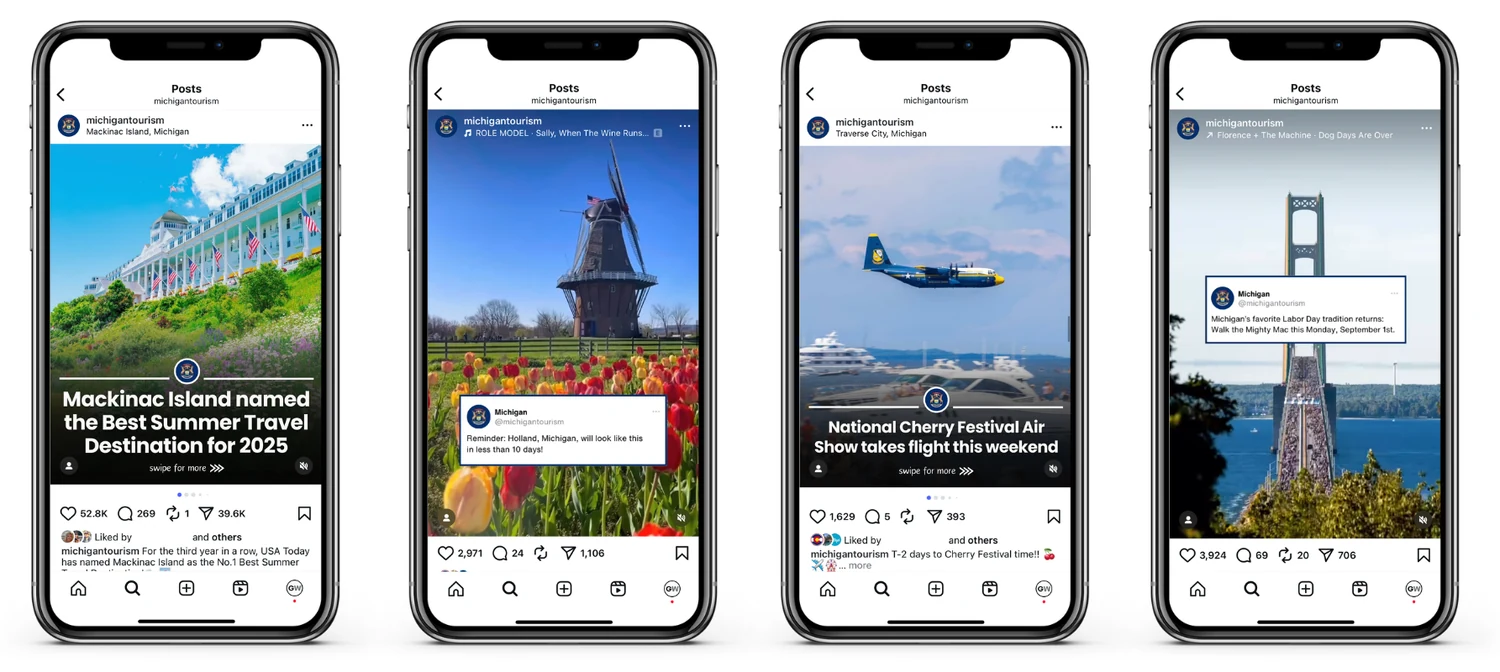
What a destination can promote
How a partnership works
The bureau’s team knows the community. The outlet’s team knows what content travels: which topics, designs, and wording get saved, shared, and acted on. A partnership combines the two.
- A shared plan. Both teams work from one shared planning document, where post ideas are proposed, feedback is given, and timelines and drafts are tracked.
- Collaborative topics. The bureau brings priorities and local knowledge. The outlet pitches angles it expects to perform.
- Content in the outlet’s format. Posts are designed in the style the audience already recognizes and trusts, so they read as part of the feed and not as an ad.
- Light lift for small teams. Most of the bureau’s work is approving ideas and drafts.
What a partnership can include
Partnerships usually run for a year and are built from a mix of deliverables, sized to the organization’s goals and budget:
- Custom feed posts. Images, carousels, or Reels on the outlet’s main feed, from bold headline posts to visual showcases.
- Reel collaborations. A Reel from the bureau, or from a creator it has hired, cross-posted to the outlet’s feed so it reaches both audiences.
- Custom Story posts. One or two frames with a clear call to action, such as a link to an event page or trip planner.
- Shared Story posts. The outlet reshares content from the bureau, its creators, or local businesses it wants to support.
- Special campaigns. Giveaways, photo contests, rankings, and other one-off ideas built around a specific goal.
Feed posts can also come with a guaranteed minimum number of views. If a post falls short on its own, the outlet boosts it until it gets there, at no extra cost to the bureau.
It works alongside influencers, not instead of them
Creators are great at capturing a place and showing what it feels like to be there. Local outlets are great at distribution. If a bureau already works with creators, an outlet partnership extends that work: the creator makes the content, and the outlet puts it in front of a much larger local audience through collaborations and reshares.
An example from Michigan
UP Travel and Michigan Tourism
UP Travel is the regional CVB for Michigan’s Upper Peninsula. In 2026 it began a year-long partnership with Michigan Tourism, a statewide outlet in our network.
The team had two goals: year-round visibility for a region that often gets reduced to fall color, and a partnership that would not add work for a small staff. So the plan spread feed posts across the seasons instead of stacking them into one campaign window, with Story shares in between to keep the region top of mind.
One early post shows how it works in practice. The outlet pitched a winter post about the ice shelves along the lakeshore. UP Travel approved it within a day. The outlet handled the design and publishing, and the bureau’s part was saying yes and replying to comments.
The bureau’s own following grew 19% in eight months
Followers on the CVB’s Instagram account, before and during the partnership
Every share put the region in front of someone who was not following either account.
Results like these are not guaranteed every time. Some posts take off and some perform closer to average, which is why a guaranteed minimum on views matters: it sets a floor under the investment.
The takeaway: a destination does not need a bigger content team to stay visible all year. It needs a steady presence on an account travelers already follow.
Is your organization a fit?
This model works in any state or region with an established local outlet. It tends to fit best when:
- Most of your visitors come from within your state or a neighboring one
- You want year-round visibility, not one seasonal push
- Your team is small and needs a partner that handles the content work
- You have photos or video from past seasons and events to work with
If that sounds like your organization, reach out and we’ll show you which outlets cover your region and what a partnership could look like.
For CVBs and DMOs
See which outlets reach travelers in your region.
Tell us about your destination and your goals for the year. We’ll come back with outlet options and a partnership plan sized to your budget.